
My Journey with Ghana’s clay: Founding Baobab & Neem

Hi I’m Esi, an apprentice Potter and founder of Baobab & Neem.
My journey with clay didn’t begin with a grand plan. It began in 2023 with a quiet curiosity. I wanted to understand Ghanaian clay and the process of shaping something slowly, by hand.
What started as a hobby quickly became an apprenticeship under the guidance of master potters (who I’m privileged to call my friends).
Lessons from two incredible master potters
I began understudying Faith, a third-generation female potter. Faith taught me how Ghanaian clay behaves, how to knead, hand build and fire clay using Ghanaian traditional pottery techniques. The more I studied from Faith, the more I learned about the vibrant community of Ghanaian women who have preserved our pottery traditions for decades. Faith taught me that in Ghana, we don’t rush pottery. We go with the flow of the weather. Our production is slow, and unrushed but the results are worth the wait.
My path also led me to one of Ghana’s oldest master potters, a man with over 41 years of experience. Working with him taught me that pottery in Ghana means working with what is available to get what you want. He showed me that pottery in Ghana is built on shared knowledge. It is a legacy passed down through decades of practice, labor and patience.
One of the most profound lessons I learned from both my teachers is that not all clay from Ghana is the same. Each region and each pit, has its own clay with unique characteristics.
I learned that these characteristics dictate everything. Some clays thrive in the intense heat of a traditional open fire, while others work better in the controlled environment of a kiln. Understanding how a specific clay behaves during firing is an art form in itself. At Baobab & Neem, we respect these nuances, choosing the right firing method to bring out the best in the specific clay we use.
Another intriguing lesson I learnt was that master potters are like master chefs. Since they prepare their own clay recipes in Ghana, they know how to harvest and mix different types of clay, to achieve the perfect clay recipe. Sometimes this means mixing clay from different parts of Ghana for the best recipe.
You will notice that we intentionally leave parts of each piece unglazed. This is to show you the raw beauty of Ghanaian earthenware clay. Every piece is fired in a gas kiln hand-built by my teacher. No two pieces are the same.
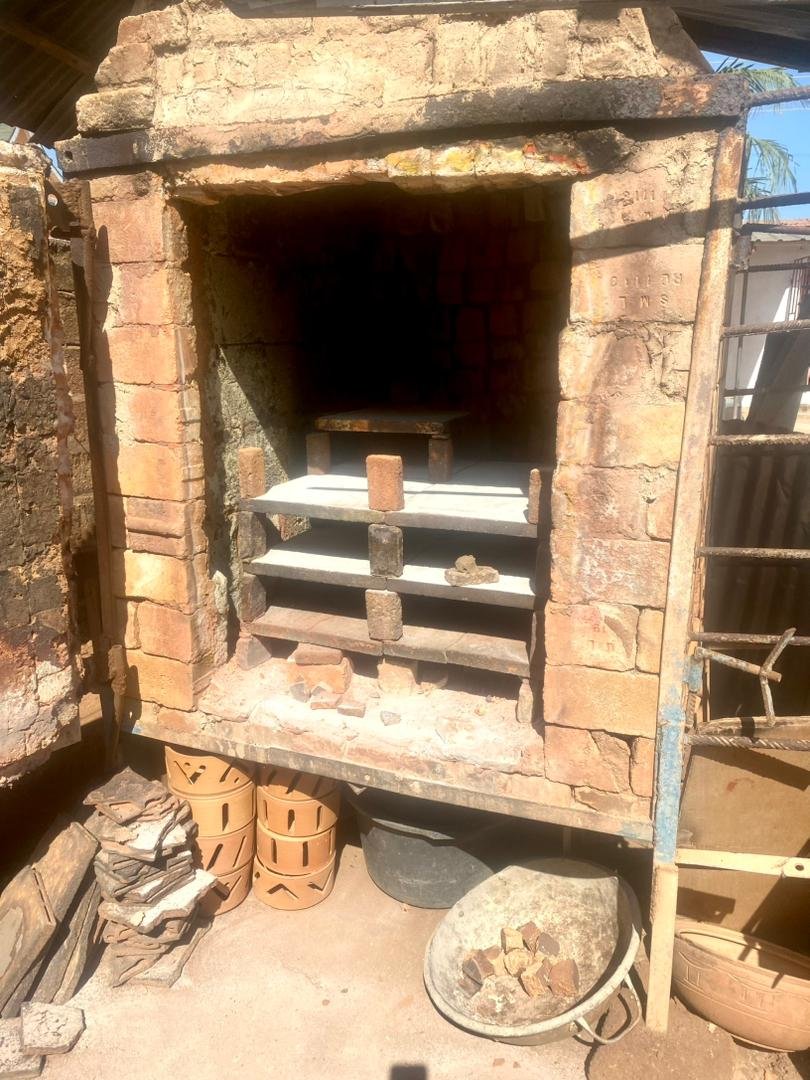
Our kiln was hand built by my pottery master 10 years ago
Why Baobab & Neem?
As I worked, I realized that pottery in Ghana is more than a craft. Pottery in Ghana is about community, patience and resilience. Baobab & Neem was born from this realization. Inspired by the Baobab tree and the Neem tree, trees that represent shade, community and resilience, these trees remind me of the community of potters in Ghana, especially the community of skilled female master potters in the Volta region of Ghana. Their warmth, resilience and dedication to their craft continue to inspire everything we do.
I invite you to explore our pieces. Slowly made pieces, shaped by time and tradition, formed and fired in Ghana.
Welcome to Baobab & Neem!
